
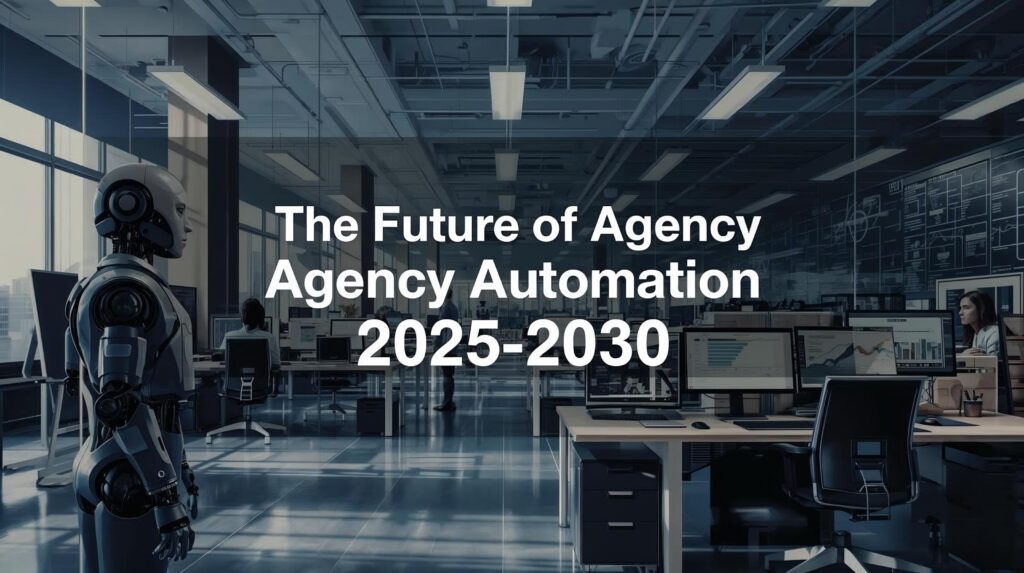
The manual death spiral has begun. Specifically, many agency owners are currently trapped in a cycle of “administrative friction” where every new client necessitates a new hire. Therefore, your profit margins are being cannibalized by rising headcount costs and human error. Consequently, the traditional model of scaling through “more bodies” is failing. If you do not adopt a comprehensive Agency Automation strategy today, your firm will likely be obsolete by the time 2030 arrives.
Most founders feel the weight of operational chaos. Instead of innovating, they are fixing broken Zapier links. Instead of selling, they are chasing team updates. Instead of leading, they are drowning in the mundane. To break this cycle, you must view Agency Automation as your new primary architect. Ultimately, the future belongs to those who build machines that work while the humans think.
💎 The 2025 Pivot: Why Agency Automation is Now Non-Negotiable
We have entered the era of the “Agentic Workflow.” In the past, we relied on simple “if-this-then-that” logic to move data between apps. However, 2025 marks the point where AI agents can now reason, plan, and execute multi-step tasks without constant human intervention. Moreover, the barrier to entry for high-level Agency Automation has dropped, meaning your competitors are already deploying these systems to undercut your pricing.
Systems are the future. Systems are the leverage. Systems are the only way to scale.
By ignoring the potential of Agency Automations, you are essentially choosing to fight a modern war with primitive tools. Furthermore, the cost of specialized labor is rising, while the cost of compute is falling. In addition, clients are beginning to demand the speed and precision that only a fully integrated Agency Automation stack can provide. Consequently, the pivot toward total autonomy is no longer a luxury—it is a survival mechanism.
🧠 The Evolution of Autonomy: From Zaps to Autonomous Agents
The next five years will see a total decoupling of “output” from “hours worked.” Specifically, we are moving away from “linear” automation toward “exponential” systems. Therefore, your Agency Automation will soon handle everything from initial lead qualification to final project delivery. Indeed, the deep-dive into this evolution reveals that “Agentic AI” will soon manage your entire fulfillment department.
Think of Agency Automation as an invisible workforce. Specifically, this workforce never sleeps, never asks for a raise, and never forgets an SOP. Moreover, as LLMs (Large Language Models) become more sophisticated, they will act as the connective tissue between your CRM, your project management tools, and your client communications. Ultimately, the goal of Agency Automations is to create a self-correcting organism that scales effortlessly.
⚙️ The Architecture of Intelligence: A Technical Breakdown
To build a future-proof firm, you must understand the “Tech Stack of 2030.” Specifically, it is no longer just about having a CRM; it is about how that CRM feeds into your Agency Automation engine. In addition, you need to prioritize “API-first” architectures that allow for seamless data flow across your entire ecosystem.
| Component | 2020 Standard | 2025-2030 Prediction (Agency Automation) |
| Lead Generation | Manual Prospecting | Autonomous AI Outreach Agents |
| Client Onboarding | Manual Form Sending | Dynamic, AI-Led Portal Setup |
| Content Creation | Human Writers/Designers | Human-Guided AI Co-Pilots |
| Reporting | Monthly PDF Manual Syncs | Real-Time, Predictive Dashboards |
Data drives decisions. Decisions drive actions. Actions drive results.
By integrating these components into your Agency Automation strategy, you eliminate “data silos.” Furthermore, using vector databases allows your AI to “remember” every past client interaction, providing a level of personalization that was previously impossible. In contrast, agencies that stick to manual data entry will suffer from a crepuscular decline in accuracy. Ultimately, your technical architecture is the foundation of your competitive moat.
📈 Market Dominance: Real Agency Use Cases for Agency Automation
The most profitable agencies in 2030 will be those that “Productize” their service through Agency Automation. Specifically, look at the world of media buying. Instead of a human manually adjusting bids, an automated script can analyze millions of data points per second to optimize ROAS. Therefore, your Agency Automation becomes the primary value driver for the client.
Another use case is in client retention. Specifically, you can deploy Agency Automation to track “Client Sentiment” by analyzing Slack messages and emails. If the system detects frustration, it can automatically trigger a “Success Sequence” to resolve the issue before the client churns. Furthermore, this proactive approach is what allows you to charge premium retainers. Consequently, Agency Automation is as much a sales tool as it is an operational one.
🛠️ The Seven-Step Implementation Framework for Agency Automation
Transitioning to a high-level automated state requires a disciplined approach. Specifically, you cannot automate a mess. Therefore, you must follow a strict protocol to ensure your Agency Automation actually serves your growth rather than complicating it.
- Process Audit: Map out every single manual click in your current workflow.
- Data Clean-up: Ensure your CRM data is structured for Agency Automation ingestion.
- Tool Consolidation: Remove redundant apps that don’t talk to each other.
- Agentic Design: Build your first “AI Agent” for a specific task (e.g., Lead Scoring).
- Feedback Loops: Set up triggers to notify humans when the Agency Automation needs help.
- Beta Testing: Run the system in parallel with your manual process for two weeks.
- Full Deployment: Shift the manual labor to the “Exception Handler” role.
⚠️ Pitfalls to Avoid: Common Mistakes in Agency Automation
The biggest mistake is “Over-Automation.” Specifically, if you automate the human relationship, you lose the “Soul” of your agency. Therefore, your Company Automations should handle the tasks, while your humans handle the strategy. In contrast, some founders try to replace their entire account management team with bots, leading to a massive churn in high-ticket clients.
Another error is “Fragmented Logic.” Specifically, when you have ten different Zaps running without a central “Source of Truth,” your Agency Automation will eventually break. Moreover, the cost of fixing a broken automated system is often higher than doing it manually. Consequently, you must invest in “Clean Code” and robust documentation from day one to ensure your Agency Automation remains sustainable.
🏆 Mastering the Machine: Best Practices for Implementation
To win, you must treat your Agency Automation as a living asset. Specifically, you should appoint an “Automation Officer” whose only job is to optimize these workflows. Furthermore, you should conduct monthly “Automation Audits” to identify new bottlenecks that can be removed. In doing so, you maintain a culture of constant optimization.
Focus creates power. Power creates speed. Speed creates scale.
By prioritizing the “Developer Experience” within your agency, you attract better talent who want to work with modern tools. In addition, use your Agency Automation to provide your team with “Decision Support” rather than just task lists. Ultimately, this empowers your people to do their best work while the machines handle the rest. Consequently, the synergy between human and machine becomes your greatest asset.
💰 The Economics of Autonomy: Cost Insights + ROI Breakdown
The ROI of Agency Automation is often misunderstood. Specifically, don’t just look at the software subscription cost; look at the “Opportunity Cost” of your team’s time. If you can save 40 hours of a senior strategist’s time per month through Agency Automation, you have essentially added $20,000 of “Found Time” to your bottom line.
| Investment Type | Monthly Cost | Efficiency Gain (ROI) |
| Manual Labor (Junior) | $3,000 – $5,000 | 1.0x (Linear) |
| Agency Automation Stack | $500 – $1,500 | 5.0x – 10.0x (Exponential) |
| AI Specialist/Engineer | $6,000 – $10,000 | 20.0x (Multiplier) |
Margin is king. Margin is freedom. Margin is the goal.
When you invest in Agency Automation, you are buying back your future. Therefore, the “Break-even” point usually occurs within the first 90 days of implementation. In addition, once the system is built, the cost of adding a new client drops to nearly zero. Consequently, your Company Automations allows you to reach “Infinity Scale” without the “Infinity Headache.”
🏗️ How NDT Legacy Group Bridges the Automation Gap
Navigating the future of Agency Automation alone is a daunting task. Specifically, most founders don’t have the time to learn Python, API documentation, or LLM prompt engineering. Therefore, NDT Legacy Group specializes in building the “Invisible Infrastructure” that powers elite agencies. By partnering with us, you gain access to a pre-built library of Agency Automation frameworks that have been tested in the trenches.
We don’t just give you tools; we give you a new business model. In contrast to traditional consultants, we focus on “Done-For-You” implementation. Specifically, we audit your current mess and replace it with a mellifluous automated engine. Ultimately, we ensure your transition to 2030 is profitable, predictable, and stress-free.
📈 The 300% Growth Blueprint: Case Study Example
Consider the case of a mid-sized SEO agency that was stuck at $1M ARR. Specifically, they couldn’t scale because the founder was manually checking every client report. By deploying a comprehensive Agency Automation suite, they automated 90% of their data collection and reporting. Consequently, the founder was able to focus entirely on high-ticket sales. Within 12 months, the agency grew to $3M ARR with the exact same headcount. This is the power of a sentient firm.
🔑 Your Decisive Next Step: Own the Future with Agency Automation
The window to gain a “First-Mover Advantage” in the Agency Automations space is closing. By 2030, these systems will be the baseline, not the differentiator. The acumen you show today by investing in your infrastructure will be the reason you are still in business five years from now. Do not be deterred by the solitude of high-level building; the effervescent growth that follows is worth the effort.
Avoid the quixotic dream of scaling manually. Embrace the propensity for excellence that comes with a machine-led operation. Your diaphanous vision for a 7-figure firm starts with a single automated trigger. The exquisite balance of human strategy and Agency Automation is the penultimate step to your freedom.
Ready to build your 2030-ready agency today?➡️ Schedule an Automation Strategy Audit Now to Future-Proof Your Growth!
FAQ
Q1: Will Agency Automation replace my account managers?
Undeniably, it will replace their tasks, but not their roles. Specifically, your account managers will transition from “Data Entry Clerks” to “Strategic Partners.” Furthermore, Agency Automation provides them with the data they need to have deeper, more impactful conversations with clients. Consequently, your team becomes more valuable, not less.
Q2: Is Agency Automation secure for client data?
Technically, it is often more secure than manual handling. Specifically, you can set up encrypted API bridges that move data without human eyes ever seeing it. Moreover, by using professional Agency Automation platforms, you gain enterprise-grade security protocols that a standard spreadsheet lacks. In doing so, you protect your brand’s reputation.
Q3: How much coding knowledge do I need for Agency Automation?
Ultimately, you need “Logic Knowledge” more than “Code Knowledge.” Specifically, while “No-code” tools are powerful, the future of Agency Automation involves “Low-code” AI assistants. Therefore, you don’t need to be a developer, but you do need the sagacity to understand how systems connect. Alternatively, you can hire a partner like NDT Legacy Group to handle the technical depth.
Q4: What is the biggest threat to Agency Automation success?
Fastidiousness in your data structure is the only way to avoid failure. Specifically, “Garbage In, Garbage Out” still applies to the most advanced AI. If your data is messy, your Agency Automation will produce messy results. Consequently, the verisimilitude of your automated insights depends entirely on your foundational data hygiene.