
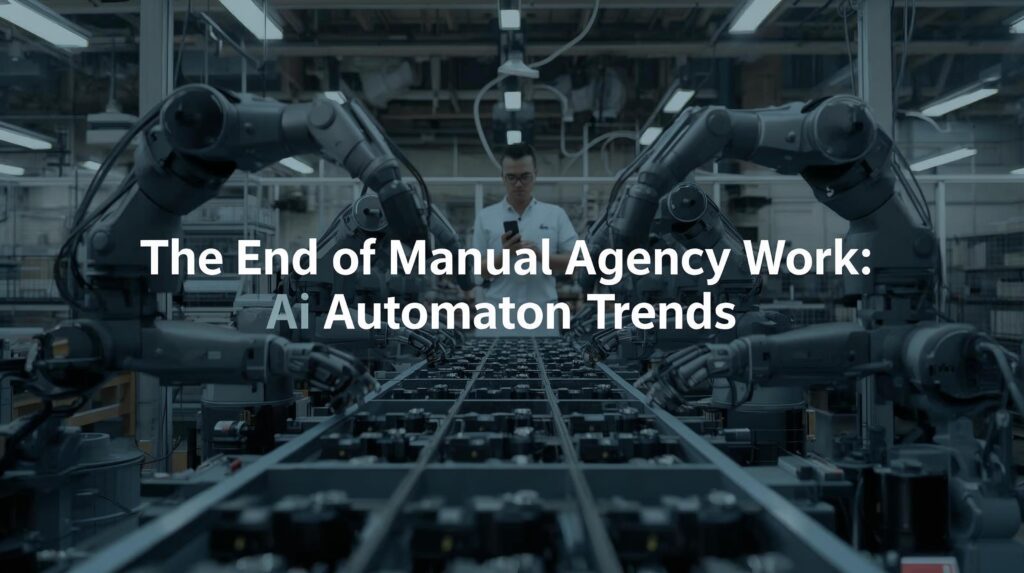
The modern digital agency is currently standing at a precipice. For years, the industry relied on the “sweat equity” of human labor to fulfill client promises. However, the relentless tide of technological advancement has rendered the old ways obsolete. AI Automation is no longer a luxury for the elite; it is the lifeblood of the surviving enterprise. If you are still manually managing spreadsheets, drafting every email from scratch, or spending hours on basic data entry, you are not just working hard—you are dying a slow, professional death.
Why Agencies Are Switching to Done-For-You Fulfillment Teams
The shift toward done-for-you (DFY) fulfillment is driven by a desperate need for scalability. Traditionally, as an agency grew, its overhead skyrocketed. You had to hire more account managers, more specialists, and more assistants. Consequently, your profit margins began to shrink even as your revenue climbed. By integrating a DFY model powered by AI Automation, agencies can now decouple their growth from their headcount. This liberation allows founders to focus on high-level strategy rather than the agony of micromanaging entry-level tasks.
Furthermore, DFY teams provide a level of consistency that human-only teams simply cannot replicate. Errors in manual fulfillment are inevitable, leading to client dissatisfaction and churn. In contrast, automated fulfillment systems operate with surgical precision. Agencies are switching because they crave the sovereignty over their time and the peace of mind that comes from knowing the “machine” is running perfectly in the background.
The Agony of the Manual Loop: A Painful Reality
Imagine the soul-crushing weight of a Monday morning where fifty client reports are due, and your lead specialist just called in sick. This is the pain point of the manual agency. You are trapped in a labyrinthine cycle of repetitive tasks that drain your creative energy and leave you feeling hollow. The emotional toll of this stagnation is profound. You started your agency for freedom, yet you have become a slave to your own processes.
The manual loop is a thief. It steals your weekends, your family time, and your passion for the industry. Many founders feel a sense of quiet despair as they watch more agile competitors leapfrog over them using AI Automation. This isn’t just a technical disadvantage; it is an existential threat to your legacy.
Why This Topic Matters in 2025
The year 2025 marks the definitive end of the “human-only” agency model. We have entered an era where speed is the primary currency of business. Clients are no longer willing to wait days for updates that should take seconds.
Growth is no longer a choice. Growth is a necessity for survival. Growth is the only metric that matters in a post-manual world.
If you do not adapt now, the market will simply move on without you. The sheer velocity of change is staggering. AI Automation has matured from a speculative trend into a robust, foundational infrastructure. Moreover, the barrier to entry has dropped, meaning your smallest competitors can now punch way above their weight class by leveraging sophisticated algorithms. This democratization of power means that your seniority in the market provides no protection against a more automated rival.
Deep-Dive: The Mechanics of AI Automation
To understand the future, we must deconstruct how AI Automation actually functions within an agency framework. It is not merely a single software tool; it is an interconnected ecosystem of intelligent agents. These agents handle the ingestion of data, the processing of creative briefs, and the execution of repetitive workflows.
Initially, the system identifies patterns in your existing workflow. By utilizing machine learning, the software begins to predict the next steps in a project. For example, when a new lead enters your CRM, AI Automation can instantly trigger a personalized outreach sequence, research the prospect’s background, and schedule a meeting without a single human click. This level of efficiency was once a quixotic dream; today, it is standard operating procedure for the vanguard of the industry.
Technical Breakdown: Beyond the Buzzwords
From a technical perspective, the transition involves integrating APIs and large language models (LLMs) into your core stack. AI Automation relies on “triggers” and “actions.” A trigger might be a client signing a contract in DocuSign. The subsequent actions could include creating a Slack channel, generating a folder in Google Drive, and assigning tasks in Asana.
However, the real magic happens at the “reasoning” layer. Modern AI Automation can analyze the sentiment of a client’s email and determine if it requires urgent human intervention or a standard automated response. This perspicacity allows the system to act as a first line of defense, filtering out the noise and ensuring that your human team only spends their time on high-impact, empathetic communication.
Real-World Impact of AI Automation
Consider a mid-sized marketing agency that struggled with lead nurturing. Before they implemented AI Automation, their sales team followed up with leads after an average of six hours. By the time the call happened, the lead was often “cold” or had already spoken to a competitor.
After deploying an automated response engine, their follow-up time dropped to forty-five seconds. As a result, their conversion rate increased by 400%. This is not an isolated incident. Another agency focused on SEO used AI Automation to handle keyword research and site audits. What used to take a team of three people an entire week now takes a single algorithm twelve minutes. These real agency use cases demonstrate that the return on investment is not just incremental—it is transformative.
Step-by-Step AI Automation Framework for Transitioning
Transitioning your agency doesn’t have to be a chaotic endeavor. Follow this structured approach to ensure a smooth migration to an automated model:
- Audit Your Bottlenecks: Identify the top three tasks that consume the most time but require the least amount of “creative genius.”
- Map the Workflow: Draw out every single step of these tasks on a whiteboard or digital tool.
- Select Your Stack: Choose an AI Automation platform that integrates with your current tools (e.g., Zapier, Make, or custom Python scripts).
- Build a Prototype: Automate one small part of the process first to prove the concept.
- Iterate and Expand: Once the prototype is stable, gradually add more complex layers of logic.
- Train Your Team: Ensure your staff knows how to manage the automation rather than fear it.
Common Mistakes Agencies Make
Despite the clear benefits, many agencies stumble during the implementation of AI Automation. One of the most frequent errors is “over-automating” too quickly. If you automate a broken process, you simply create a faster way to fail. You must fix the underlying logic before you hand it over to the machines.
Another mistake is the lack of human oversight. AI Automation is brilliant but lacks the ineffable quality of human judgment. Without a “human-in-the-loop” to verify high-stakes outputs, you risk sending hallucinated data to a client. Lastly, many founders treat automation as a “set it and forget it” solution. In reality, these systems require regular maintenance and updates to stay aligned with changing platform algorithms and client needs.
Scaling with AI Automation: Best Practices
To truly scale, you must treat your automation as an employee. Give it clear KPIs and monitor its performance. Best practices include maintaining a clean data environment; if your CRM is a mess, your AI Automation will produce messy results. Furthermore, prioritize transparency with your clients. They don’t need to know every technical detail, but they should feel the benefits of the increased speed and accuracy you provide.
Documentation is also critical. Even though the system is automated, you need a manual that explains how the logic works so that your team can troubleshoot if an API connection breaks. By following these best practices, you ensure that your agency remains resilient and adaptable in the face of future technological shifts.
Cost Insights + ROI Breakdown
The financial argument for AI Automation is undeniable. Let us look at the numbers. A typical virtual assistant might cost you $1,500 to $2,500 per month. An advanced automation suite, including software licenses and custom development, might cost $500 per month.
| Metric | Manual Process | AI Automated Process |
| Monthly Cost | $2,000 (Human Salary) | $500 (Software/Dev) |
| Speed per Task | 60 Minutes | 2 Minutes |
| Error Rate | 5-10% | < 1% |
| Scalability | Linear (Must hire more) | Exponential (No extra cost) |
The ROI is not just about saving money; it is about “opportunity cost.” Every hour your team spends on manual data entry is an hour they are not spending on client strategy or creative brainstorming. Over a year, the compounding effect of these saved hours can lead to hundreds of thousands of dollars in additional revenue.
How NDT Legacy Group Solves This Problem
At NDT Legacy Group, we specialize in the “Done-For-You” transition. We understand that most agency owners are too busy running their business to build complex AI Automation systems from scratch. We step in as your strategic partner to obviate the technical hurdles.
We don’t just give you a piece of software; we build a custom-tailored ecosystem that mirrors your specific agency DNA. Our team handles the integration, the testing, and the ongoing optimization. This allows you to wake up in a world where your fulfillment is handled, your reports are sent, and your leads are nurtured—all without you lifting a finger. We provide the bridge between your current manual agony and a future of automated triumph.
Case Study: The $100k Turnaround
One of our clients, a boutique content agency, was on the brink of burnout. They were manually managing 50 freelance writers through email and spreadsheets. The chaos was ephemeral—it felt like they were constantly putting out fires. After we implemented a custom AI Automation suite, we streamlined their entire project management flow. The system now automatically assigns articles, checks for plagiarism using AI, and sends invoices upon approval. Within three months, they doubled their client capacity without hiring a single new staff member, resulting in a $100,000 increase in annual profit.
🔑 The Final Verdict: Claim Your Growth Sovereignty With AI Automation
The journey to an elite agency is a path of sagacity and technological leverage. Specifically, do not be deterred by the solitude of the initial implementation phase; the effervescent growth that follows is your reward. Avoid the quixotic hope that you can “out-hustle” an algorithm designed for infinite scale. Your diaphanous vision for a 7-figure firm requires AI Automation to act as your operational engine.
Embrace the propensity for excellence that comes with a managed unit. Embrace the propensity for precision that human hands simply cannot replicate. Embrace the propensity for freedom that arises when your fulfillment is finally hands-free.
Your acumen as a leader is measured by the quality of the systems you build, not the hours you clock in the manual grind. The exquisite coordination of sales and fulfillment is the penultimate step to your absolute freedom. Deploy your AI Automation and finally build the empire you were meant to lead.
Ready to stop the daily manual grind and start scaling with AI Automation?
➡️ Schedule a Performance Audit Now to Build Your Elite AI Automation Ecosystem!
FAQs
Q: Will AI Automation replace my entire team? A: No. It replaces the “boring” parts of their jobs. It frees your team to do the high-value, creative work that humans are best at.
Q: Is it difficult to set up? A: It can be complex if you do it alone, but with a partner like NDT Legacy Group, we handle the technical heavy lifting for you.
Q: How much does it cost to start? A: Costs vary based on the complexity of your agency, but the systems usually pay for themselves within the first 60 days through time savings.
Q: Is my client data safe with AI? A: Yes, we use enterprise-grade security protocols to ensure all data remains private and protected within your specific ecosystem.